
Agriculture in 2026: Why Protected Growing Is Becoming More Important

Agriculture has always required growers to adapt. In 2026, however, that adaptation is happening faster and across nearly every part of the industry.

Worldwide, growers are managing extreme weather, changing water availability, higher production costs, labor challenges, shifting markets, pest and disease pressure, and uncertainty surrounding energy and agricultural inputs. Here in California—and especially throughout the Salinas Valley—those worldwide pressures are being felt on a very local level.
The result is a growing need for agricultural systems that offer greater protection, efficiency, flexibility, and control.

The Worldwide Agricultural Picture
Global demand for agricultural products continues to rise, particularly in middle- and lower-income countries where population growth, urbanization, and changing diets are increasing food consumption.
The latest OECD-FAO Agricultural Outlook projects that worldwide consumption of agricultural and fish products will increase by approximately 12.5% over the coming decade.
Meeting that demand will depend largely on productivity—producing more efficiently from the land, labor, water, and resources already available.
At the same time, agriculture is becoming increasingly vulnerable to:
Extreme heat and unpredictable weather
Drought and water scarcity
Flooding and excessive rainfall
Higher energy and fertilizer costs
Labor availability and rising wages
Global trade and supply-chain disruptions
Expanding pest and disease pressure
These conditions affect everything from planting schedules and crop quality to transportation, market pricing, and the availability of agricultural inputs.
Growers are therefore looking beyond short-term fixes. They are evaluating how their entire production system can become more resilient.
What Is Happening in the Greenhouse Industry?
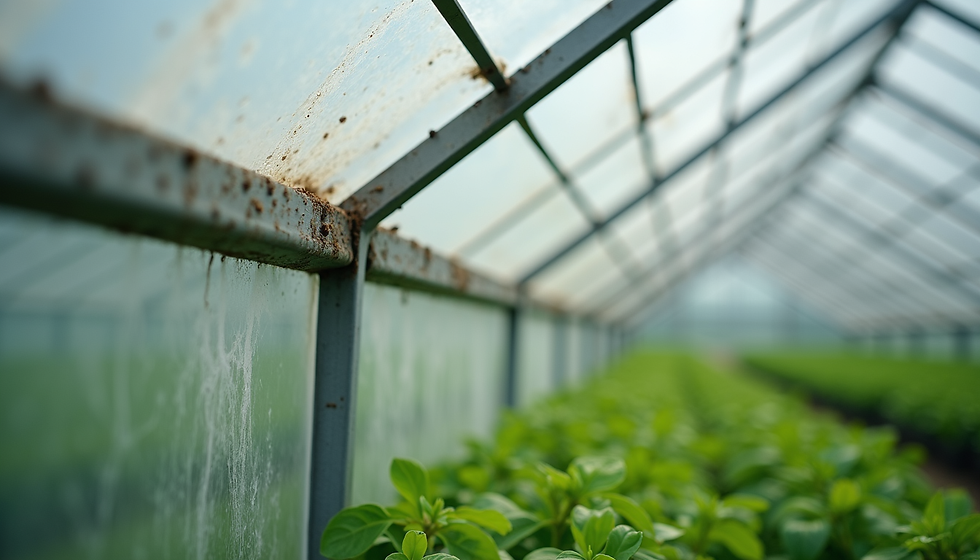
Greenhouses, high tunnels, hoop houses, shade structures, and other forms of controlled-environment agriculture are receiving increased attention because they help growers manage some of the variables that open-field production cannot control.
Protected structures can create a more stable growing environment while helping producers:
Protect crops from wind, rain, frost, hail, and excessive exposure
Extend production into earlier or later growing seasons
Improve irrigation and nutrient-delivery precision
Reduce weather-related crop losses
Improve crop uniformity and quality
Manage pest access and pesticide drift
Support higher-value and specialty crops
Make more productive use of limited acreage
The USDA Natural Resources Conservation Service recognizes that high tunnels can protect plants from severe weather, extend growing seasons, support precise drip irrigation, and give growers greater control over certain pest pressures.
However, protected agriculture is not simply about putting a covering over a crop. A successful structure must be appropriate for the crop, climate, site, and production goal.
Ventilation, covering selection, airflow, drainage, irrigation, temperature management, structural strength, and future expansion all need to be considered. Without proper planning, a structure can trap excessive heat or humidity and create a different set of crop-management problems.
This is why the greenhouse conversation is moving from simply “growing under cover” to designing complete production environments.
California Agriculture: Productivity Under Pressure
California remains one of the most productive agricultural regions in the world. The state is a leading producer of more than 70 commodities and exports over $20 billion in agricultural products.
That productivity depends heavily on reliable water management. According to the California Department of Water Resources, approximately 9.6 million acres are irrigated during an average year.
Even small gains in water-use efficiency can therefore make a meaningful difference.
Greenhouses and high tunnels are not a universal answer to California’s water challenges, but they can be part of a larger efficiency strategy. Protected production can support carefully targeted drip irrigation, reduce direct exposure to unwanted rainfall, and give growers more control over when and how water and nutrients reach the crop.
California growers are also facing substantial labor, fuel, fertilizer, equipment, compliance, and pest-management costs. These pressures make it increasingly important to evaluate investments based on the value they provide over time—not simply their initial purchase price.
A well-planned structure should help solve a specific production problem, protect crop
value, and fit into the grower’s long-term operation.
What This Means for the Salinas Valley
The Salinas Valley remains one of the most valuable and productive agricultural regions in the country.
Monterey County’s leading crops for 2025 included strawberries, leaf lettuce, head lettuce, broccoli, cauliflower, celery, spinach, nursery and flower products, wine grapes, and livestock. Strawberries and leaf lettuce each exceeded $1 billion in gross production value, according to the Monterey County Farm Bureau.
Those numbers demonstrate the strength of local agriculture—but gross production value is not the same as grower profit.
The Farm Bureau also reports that growing, harvesting, packaging, pest-management, labor, and post-harvest expenses substantially reduce margins. For several major local crops, production costs can approach or even exceed gross value depending on yield, quality, and market conditions.
That makes crop protection especially important.
A weather event, pest outbreak, delayed harvest, irrigation problem, or decline in marketable quality can affect an entire season’s profitability. For high-value crops, the ability to protect quality and improve production consistency may be just as important as increasing overall yield.
Local growers are consequently asking more detailed questions:
Can we extend the harvest window?
Can we protect a high-value crop from damaging weather?
Can irrigation and nutrient delivery become more precise?
Can we improve working conditions or operational efficiency?
Can an existing greenhouse or high tunnel be repaired or upgraded?
Can a structure accommodate different crops in the future?
Can we expand production without committing immediately to a fully controlled greenhouse?
These are not simply construction questions. They are production-planning questions.

The Future Is Flexible, Efficient, and Protected
Open-field agriculture will remain essential to worldwide food production. But growers are increasingly combining open-field systems with protected structures, crop-support systems, shade, irrigation improvements, and other technologies.
The future may not be completely controlled—but it will be more strategically protected.
For some operations, that may mean a naturally ventilated high tunnel. For others, it may mean a commercial greenhouse, nursery structure, crop-protection system, trellis installation, replacement covering, or expansion of an existing facility.
The right solution begins with understanding the crop, the site, the challenge, and the
grower’s long-term goals.
Planning Your Next Agricultural Structure
Quiedan Company has supported growers, nurseries, vineyards, and agricultural operations since 1975. From greenhouses and high tunnels to trellis systems and crop-protection solutions, our focus is on structures designed around real agricultural needs.
Whether you are repairing an existing structure, improving crop protection, considering an expansion, or planning an entirely new project, starting early provides time to evaluate site conditions, production goals, materials, ventilation, irrigation, and future growth.
Because in a changing agricultural industry, the strongest operations are not simply reacting to the next challenge.
They are building for it.
Quiedan Company Everything Grows Better With Structure®


Comments